A personal perpsective of life in our Virginia vineyard... Christine Wells Vrooman

)

6/30/2010

Berries, Bella, Sun and SAR!

Red, Black... And Blue!

The season is here! I just picked four pounds of wild red raspberries, putting three in the freezer that I will  blend into preserves with the blackberries I'll be picking next week. Scrumptious, sweet, wild.  There is no comparison in flavor to the cultivated varieties. Our red and black are wild, the blueberries cultivated.  Why are the wild so flavorful?  Well, that brings me to the explanation of "SAR", Systemic Acquired Resistance".  Simply put, it refers to the response of the plant to various elements, pathogens, diseases, etc.  The wild varieties are the products of generations of self-defense.  Studies have shown that every time a plant reacts to an attack, its defense mechanisms are stimulated; its "system acquires a resistance" to attacking pathogens.  And with that reaction in grapes, the phenolic and flavonoid compounds (chemicals that create flavor and character to wines) are released.  When a plant has an "ancestry" of strong defense mechanisms, the result is a fruit of intense flavor.
In our grocery markets, the organic produce typically has more flavor than their conventionally grown counterparts.  The conventionally treated plants that are sprayed with chemicals their entire life do not need to defend themselves to the same degree, thus are not quite as colorful and tasty. Wild blackberries are the perfect expression of SAR's benefits.  And hopefully, so will our wines! 
This is a very simplistic explanation to a very complicated process. For further reading: http://www.organicwinejournal.com/index.php/2008/11/wine-quality-organic-viticulture-and-vine-systemic-acquired-resistance-to-pests/

Shhh.... Don't Tell Dan
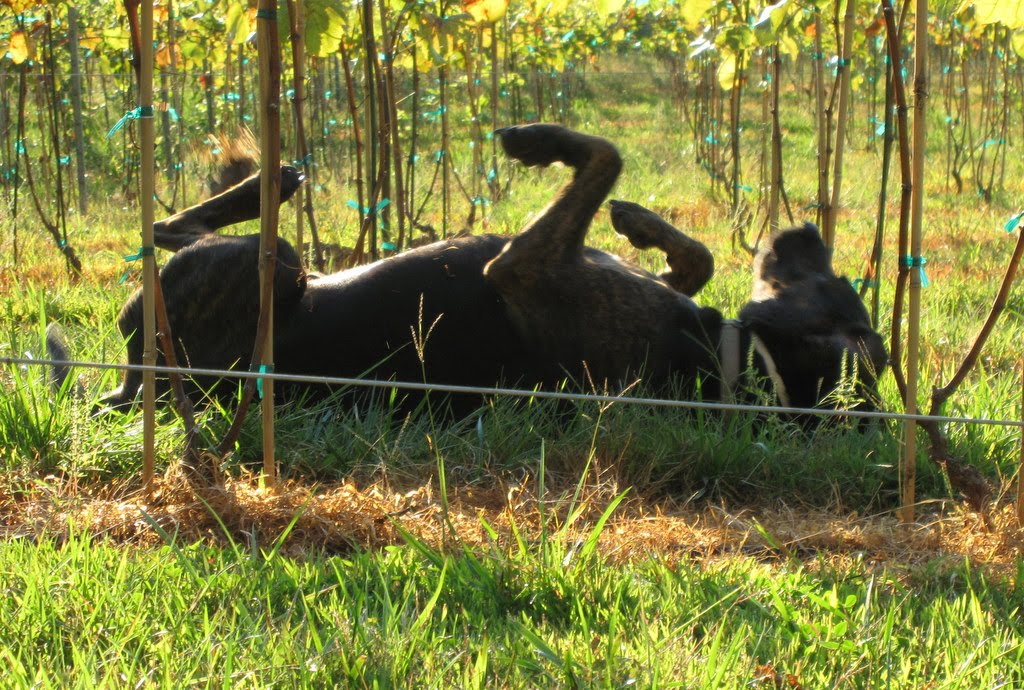
Bella is our sweet two-year-old female Maremma that helps her counter-part, ten year old, Dan, protect our flock of sheep.  Bella's cycle of reproduction is upon us.  After running some tests on Dear Old Dan, it was determined he is, alas, too old to become a proud Papa.  So after doing some research, we found a new love for Bella up in Northern Virginia.  She has spent the last week up there in the sweltering heat of this past week.  The news is good.  We apparently have a mating and if all goes according to schedule, Bella will become a first time Mama the end of August.  I am hoping Dan will forget that nothing happened between him and Bella, and he will see those babies being born and think of himself as the proud Papa we had always hoped he would be.  
Here Bella sits with her handsome one, "Gnocchi" behind her.

The Importance of Sun at Fruit Set
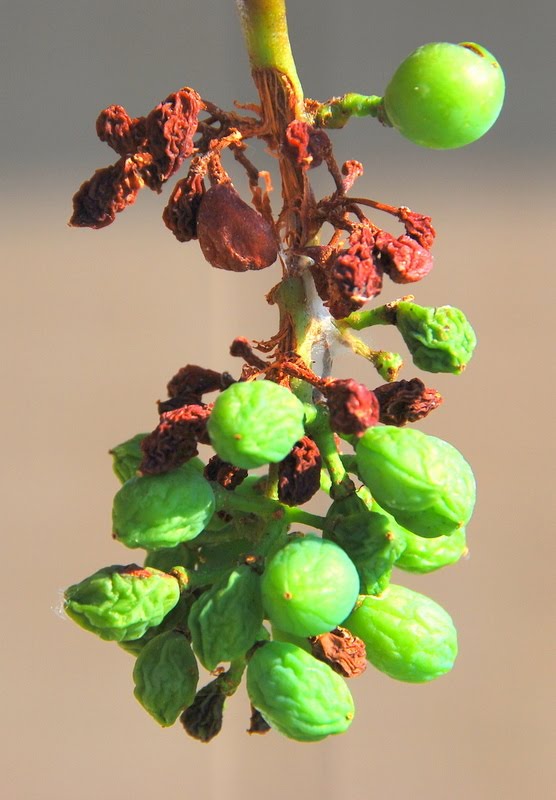
As mentioned in an earlier post, our Chardonnay bloomed during a long, wet spell, and thus the pollination of the fruit was greatly impacted.  In the images below, you can appreciate the value of sunlight at a critical time in fruit development. And we are so grateful to the "weather gods" that they spared us our beloved star, our Pinot Noir.


What Might Have Been
Walking through the vines yesterday, I stumbled upon a dreadful sight; a cluster of Black Rot infected grapes.  I am assuming the spray had somehow missed this spot and the end result speaks for itself.  Had we not sprayed our two conventional sprays directed toward this pathogen, this is what our vineyard would have looked like this year.
Be still, my heart!
With each successive year the source of the disease will be lessened, and with each year, our sprays for it will also diminish.  As much as I am opposed to the reckless use of chemicals on our earth, there are some instances where a judicious and calculated use is needed.

6/11/2010

A Visit from Mizuho
We were fortunate to have Virginia Tech's Grape Pathologist, Dr.Mizuho Nita, come for a visit to check out our vineyard last week.  As you know, organic (or near-organic) viticulture practices are rare in Virgina, as well as dense-planting of the vines.  To put the two of them together, even rarer.  Combine that with the planting of Pinot Noir grapes... unheard of in Virginia, and perhaps the entire East Coast.   As Mizuho walked through the vineyard, I noticed him nodding his head a bit.  I surmised he was liking what he saw.   I think he was impressed by the health of the vines and perhaps a bit surprised to find us essentially disease-free.  No phomopsis, no leaf-roll virus, no antracnose, no insect damage... the list is long.  And most importantly, no Black Rot! Only a spot here and there, thanks to our two conventional sprays that are considered some of the more enviro-friendly of the conventional sprays.
We do have an area in the Chardonnay block where the vines are somewhat pale in color and the growth a bit weaker in relation to the rest of the vineyard.  We are trying to figure out the issue.  I collected petiole samples (the stem from the leaf across from the fruit cluster) from both the weaker Chard and the stronger Pinot Noir vines. The results have just come back and we are finding the weaker vines to have very high potassium levels, often caused by a deficiency of magnesium.  So we will try to adjust those levels by applying some interim sprays of Mg to see if it helps.  I feel so fortunate to have such a great team of professionals in our court.  Thank you Mizuho and Lucie!

Fruit Bloom and Days of Gloom
When the Chard fruit was just beginning to bloom in mid-May, we were enveloped for the next five days by the gloomiest of weather patterns.  We had days of rain, fog, drizzle and not a drop of sunshine.  I remember emailing Mizuho and Lucie about my concern the fruit would not set in all this dark, damp weather.  And that is precisely what happened.  Much of the fruit clusters in the Chard are pitifully thin.  I suspect we will have only about half the fruit we were anticpating.  The blessing is that our Pinot bloomed about a week after the Chard, when the sun was shining.  Our Pinot clusters are thick and full.  A blessing.  The Pinot is our shining star, and we expect to have a beautiful crop of this much sought-after grape that is considered so hard to grow in Virginia.  Mizuho warned I will have to baby them as they ripen, and of course I will!  I will post an image of our beautiful Pinot soon, and you will be able to see the vast difference a bit of sunshine makes at just the right time.

Where the Wild Things Grow
It is obvious in the forests around us that the wild berries loved the heavy dose of nitrogen soaked into the earth this winter by weeks of slow-melting snow.  Our crop of wild raspberries and blackberries are going to be amazing.  I froze strawberries from last month and will be mixing them into preserves with a combination of our planted blueberries and the wild blackberries and raspberries.  The raspberries are ready to burst forth, and the blackberries will follow a couple of weeks behind them. Mmmmm....


*******


5/28/2010


Biodynamics Spoken in the East?!
I just returned from a viticulture workshop in PA, sponsored by Penn State University.  The topic: Organic, Sustainable and Biodynamic Viticulture in the Eastern US.  Amazing!:)  The organizer was hoping to have thirty or so people. Actual attendance was 60 to 75 I would estimate.  Among the presenters were two vineyards, one from Long Island, NY (Shinn Estate) and the other, Black Ankle,  from MD.  They both have been applying similar farming practices as we have, but they have been at it longer.  The general discussion followed along with our experiences in the vineyard... Black Rot is the major issue keeping Eastern vineyards from becoming certified organic or biodynamic.  But the discussion continued and the consensus was that practices of minimal input of chemicals and keeping the vines, vineyard and farm in balance with nature was the more desirable (and attainable) goal.  We tasted their wines and they were truly superb.  If you have the chance, find some of their wines so you can taste first hand the results of their environmentally sensitive vineyard practices.  Fabulous!

I feel inspired, encouraged.  There is more than just hope! We are seeing proof!
Onward, vineyard soldier!

Leaf Pulling
And now the all-important canopy management begins.  Last year we lost much of the canopy to Black Rot.  This year, we are developing a beautiful, full canopy and fruit zone.
The management of the "canopy" will be critical to our success.  We spent the last week or so pulling away the leaves on the east side around the baby berries so the morning sun and air can get to them.  By exposing the young berries to the morning sun, they develop a stronger skin and a greater ability to ward off fungal diseases later in life, it sort of toughens them up a bit.  We will keep the afternoon sun away from them till late in the summer when the sun is not so hot and the fruit are mature.  An overheated grape will "cook" a bit on the vine, losing its acidity (not a good thing) and the anthocyanins that provide color will be detrimentally affected.  So monitoring this sun exposure is very important, as is balancing the amount leaves removed for air movement with those left on the vine for adequate photosynthesis.


Intruder Egg Update
In a recent posting, I showed you the image of a bird's nest with an intruder egg, a cowbird. These birds lay their eggs in other birds' nest and let them raise their young, not a very admirable trait. I had decided to go back and remove the egg from the nest, as the baby cowbirds are much bigger than the sparrows and they end up getting all the food from mama sparrow and her real babies would not survive.  Here's the image of the eggs that I posted earlier.

So two days later I went down to Row 20 and planned on removing the egg, I guess tossing it into the woods.  And low and behold...

They had already hatched!  Now what to do.  It is a lot easier for me to toss an egg into the woods than a baby bird.  You can see the difference in size already.  When I watched the baby sparrow open its mouth for food, with the cowbird positioned to get most of the food, I decided I had no choice but to remove the cowbird.
So with two fingers, I picked up the bird by the torso and carried it up the vineyard in my hand.  I could feel it twitching and squirming and it was so warm.  Oh, I did not like this.  Not at all... having to kill this little creature... it wasn't his fault his mother is lazy.  I sat it in the warm sun on the picnic table while I struggled with how to "dispose" of it humanely.  Then I got to wondering if the mother bird might abandon the entire nest, knowing someone or something had discovered it and things just weren't right.  I just couldn't kill it.  I had to walk back down to Row 20, set it back in the nest and let nature take its course.

And nature did.  Upon checking on the nest two days later, I so hoped to find everyone doing well, growing, sharing the nest as one family.  As I approached, I could see the mother was not sitting on it.  She must be out looking for insects.  I pulled away the leaf covering the nest.  The nest was empty.  They were all gone.  I surmise a raccoon, or perhaps a snake found its way.  It was near the end of a row, close to the woods.  A few days later I checked in on another nest I knew had baby hatch-lings.  It too was empty.

I did hear two raccoons fighting in the woods a few nights ago. Time to put my hound to work. I will let BoomBoom roam the vineyard at night for a while.  He is the master 'coon hunter.  Best we get rid of these raccoons before the grapes ripen anyway.  And nothing would make BoomBoom happier than to catch himself a raccoon.  He caught one once down on the farm, and he spun himself and the raccoon in his mouth around in circles, pivoting on his hind legs, the raccoon flying in circles in the air by the centrifugal force of it.  I made him drop the little beast and it went off staggering into the woods like a drunk.  That better not be the same critter that is coming after my grapes.  Should have let nature takes its course back then, perhaps.

My sweet BoomBoom loves the vineyard life!

And just look at that face.  What's not to love?


5/22/2010

Nikon Duty

Finding the Beautiful
After days of drizzle, fog and rain, the sun is out. I am laid up with a broken toe, but cannot stay indoors another moment.  It has been too many days.  So I and my securely-wrapped toe took a brief drive into the vineyard.  I had to see how the vines had tolerated all the humid, rainy days.  I held my breath as I walked into the first row, so fearful I would be met with a display of brown spots covering the leaves.  I found one or two, but the vines looked healthy, bright green, clusters of blossoms everywhere.  Joy.  Relief.  Thankfulness. We truly are conquering Black Rot I believe.  I believe, I believe!  Another five weeks and we will be beyond the vulnerable stage.  We can do it!!


Miracle in the Details
With my Nikon, I spent some close up time with my grapes.  I can't help but be amazed by the miracle of birth, whether it be a human, animal or a grape. 

Pinot Noir in Bloom

A Closer Look

 
Zooming In

Newborn Grapes!

And To the Gardens Below
I had to continue down the driveway to the farm, orchard and gardens.  Four days of containment felt like weeks.  The lambs have grown so.  The fruit on the peach, plum, pear and apple trees and the blueberries, the sugar snap peas and rhubarb... everything has grown and developed so in these few short days. With my Nikon I sneaked into their world.  Here are some captured moments to share with you... enough beauty to help heal a broken bone!
Patience, patience I remind myself.  They will be ripe for eating before long.

 
Black Cherry Heirloom Tomato

Blueberries

 
Sugar Snap Pea Blossom

 
Sugar Snap Trying to Fill Out

Dewdrops on lettuce

Damson Plums 

A Father's Birthday
Today my WWII veteran father turns 85, and I must say he is about the youngest 85 year old I have ever known.  In spite of thirty years or so of living with COPD (Chronic Obstructive Pulmonary Disease), he is ready and rarin' to go.  He attributes his condition to his taking charge of the medications the doctors have prescribed for him over the years.  He is convinced that if he had continued taking the ultra heavy doses of steroids and inhalants as prescribed, he wouldn't be here today.  He takes less than 1/4 of what the doctor's prescribed.  His philosophy, "More is not better".  Only the minimal amount of meds needed is best for him.  And as I listened to him, I heard a common thread in my approach to viticulture.  Sometimes medication is needed, but first build a strong body, take only what is necessary to fight the disease and go from there.  Must be the acorn doesn't fall far from the tree, eh?
So Happy Birthday, dear "Pepe"!  And many, many more! Love you!