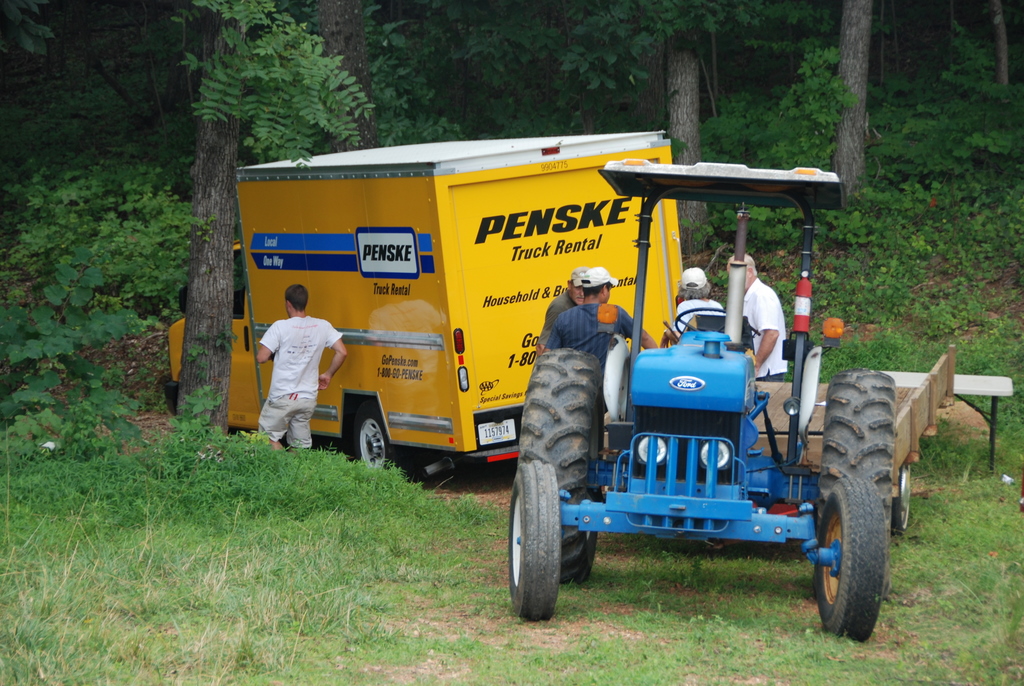
A personal perpsective of life in our Virginia vineyard... Christine Wells Vrooman

)

8/13/2010

A New Home for the Grapes

Into the cooler they went, after their hour and a half ride to the Stinson Family Winery, a delightful new winery that is perfectly suited for our precious crop. As meticulous as we are in the vineyard, they too are in their winery. Their equipment was sparkling new. In fact, our Pinot grapes were the first grapes to be processed there.

Soon after I arrived at the winery, the renowned and delightful French winemaker, Monsieur Matthieu Finot, arrived.  With quick and determined steps, he headed directly toward the cold room where the lugs of grapes were stacked.  He stood at the closed door, eyes fixed on it as it lifted.  As soon as the door was high enough for him to walk under it, he squeezed himself between the stacks and began popping berries into his mouth.  My eyes studied his, trying to read his reaction.  This was one of those moments of truth.  Just how good are these grapes?  Will they be able to make the fine wine the Stinsons hope to be able to make from our grapes? 
He stopped, still chewing the grapes and turned to me.  He nodded. And with his delightfully thick French acccent proclaimed, "Eet is goood. Zee grapes are goood!"  I wanted to jump with arms raised in victory-mode, but I restrained myself and uttered something subdued like "Really?  Wonderful!"

The grapes would rest in the cooler two nights.  On Friday at 7 am, we all convened at the winery to destem and sort the fruit.  The clouds were heavy and gray, the air a bit cooler, comfortable enough for us to process everything outside on the crush pad. An intense and exciting energy pulsated as two families of "newbies" went to work.  Matthieu moved swiftly and gracefully around the equipment, with such grace, ease and familiarity... setting up, connecting, arranging, plugging.  It was like watching a ballet.

The grapes were brought out.  In my mind, I heard the drumroll!  And the  process began. First, each lug was dumped into the destemmer that spit out the stems to one side and dropped the fruit onto the vibrating sorting table where we picked through the grapes and pulled out any leftover stems the machine missed.


We were surprised by the arrival of our daughter, Rachel, and little Owen, who came to experience first-hand the grapes-to-wine process.  Owen could not quite figure it all out, but certainly tried.

 
Below are the stems that were spit out by the destemmer and below that is the T-bin fillling up with the sorted fruit after taking a ride up the conveyor belt.  Up to the sky they rose for one brief, final moment, catching their last glint of sunlight before their life inside a toasted French oak barrel begins.


At one point the destemmer stopped functioning.  We began removing the stems by hand.  Oh... this was going to take a very, very long time.   Matthieu got on the phone and was speaking French to someone from the company in South Africa.  Seems there was a voltage setting issue.  A few adjustments. 
Let it rest. Working again.  Thank you, thank you!

In less time than I expected, we were done, the T-bin was full. 

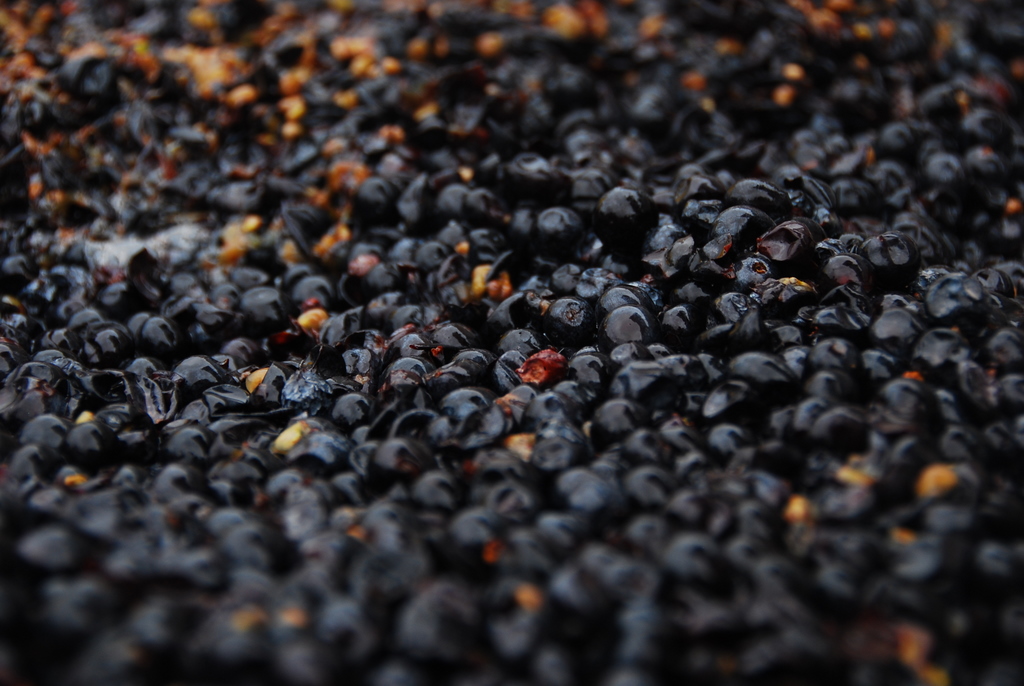
I rubbed my fingers over the grapes and smelled their sweetness.  Matthieu began working his magic.. a little of this, a little of that.. additions to protect the fruit until the fermentaion process begins after a time of chilling down first.  He plunged a hollow pipe into the fruit, stuck the end of a pump hose into the pipe and pumped over the juice from the bottom of the bin over the top of the fruit.


And then out comes a giant box of plastic wrap!  Mattthieu shows eveyone how to make a removable cover with it, one that keeps out the fruit flies, but allows the CO2 to escape.  After securing the top, Nathan slips the pallette jack under the T-bin and slowly rolls the bin into the cold room where it will spend a bit of time settling down before it is brought up to room temperature to begin the fermentation process.


And into the cooler you go!
Going..... 
Going....

Gone!...
You are on your way, my sweet grapes.


8/12/2010

Reaping The Fruits of Our Labor

I will never have to try to remember this day, August 11, 2010.  A day of symbolism, anticipation, of determination and termination.   A day to literally measure the fruit of our labors, in pounds, brix and pH, all measurements of the present, to be bottled up for the future.  I will only once in my life experience these hours of my very first harvest.
The night before I laid in bed rehearsing, going through the steps of the day to come.  Never having organized a harvest, I ran through my mind all the scenarios I could concoct... not enough lugs, collecting the lugs, too many lugs, not enough room in the truck, too much room in the truck! Cut fingers, not enough fingers.   I felt a bit blind, like I could not quite see the day ahead, only imagine it with a blurred, uncertain vision.

 I woke up as the light of day lifted from behind the mountain ridge.  It was 80° when we went to bed and it was 80° when we woke up.  The   air was thick, moist and still.  Not even the hint of a breeze on this, the muggiest morning of the entire season.  I would have loved to have harvested our grapes on a clear morning of cool, soft breezes, singing birds, humming pickers... idyllic images.  But this morning not a bird could be heard, not a leaf  a'fluttering.  But the grapes were ready and so were we.

Lugs were set out at the bottom of each row.  The netting was dropped, the vines undressed, the grapes exposed.   I reviewed to our small army of pickers the logistics of snipping, what not to pick, the dropping (ever so gently) into the lugs, how high to fill the lugs, where to move them, and so on.  With that, I sent the troops into the vines.  Charge!  Onward we go, into the great moment of harvest.


As we made our way through the rows, I stopped for a moment to take it all in.  An unexpected feeling of melancholy hit me as I looked at a naked row of  vines.  The canes were vacant, barren.  Their purpose fulfilled.  The vines had borne fruit and now would come their time of rest... and quiet.  T'was a bittersweet moment, for I had grown to so love the sight of these dangling clusters of purple berries against the green leaves and blue skies. 
 Before.... and after

It took us over four hours to harvest our little acre of vines.  But the extra time it took in the vineyard would save us time at the sorting table at the winery; the picking was clean.. no leaves to have to pluck out later.  The grapes were clean,  nary a single grape showed any sign of disease or rot.  I saw that as our first true measurement of success.  A season of meticulous care had paid off!

After the last row was cleared of fruit, we rushed to collect all the filled lugs.  We wanted to get the grapes out of the heat, into the truck and on their way to the winery one and a half hours away.  Nathan jumped behind the wheel of the truck, and he and Dennis rushed down the mountainside.  If there had been red flashing lights and a siren, he would have been using them in his "rush to the emergency room" mode!  Get these heated grapes into the cooler as fast as we can! 

When all was quiet, after everyone had left the vineyard, I sat at the picnic table with a bottle of water.  My clothes and hair wet from the heat and humidity.  My feet so very sore after a frenzied few days.  The Pinot grapes were gone.  It should have been a time of great reflection, but I was too tired and consumed with the need to get into my car and drive up to the winery to witness the next phase of our grapes' journey.  I drove up to the house for a quick shower, looking over my shoulder at the vineyard.  The years of striving for a harvest of healthy grapes.. Done!  And from those grapes, a wine of high quality that expresses the site from which it came...We're halfway there!
The thrill of victory... but oh, the agony of de'feet!   I feel a nice cool footbath comin'!

Next.... At the winery!!!

8/10/2010

Tomorrow! Tomorrow... It's Only A Day Away!

We have been facing a pressing issue in the vineyard with some of our Pinot grapes. We would like the grapes to hang on the vine a bit after they reach their full ripeness to give the grapes a bit more time to rest without necessarily ripening any more. We need cooler weather to accomplish that. We are raising these babies in a record-breaking summer. They are ripening now during the hottest of the hot! Pinot grapes do not like extreme  heat. That is why we chose them for this site. At our elevation of 1800 feet we are usually about 5 to eight degrees cooler than surrounding areas. But this heat, this heat! Those berries that ripened the earliest are beginning to shrivel in this hot sun.  They are increasing their sugar levels but are losing their juice. It is evaporating and the berries are drying up. We have to get this fruit off the vines.

But Are They Ready?  We have been measuring the sugar levels (Brix) and the pH levels every few days for the last couple of weeks.  How do we measure Brix?  Well, I gather about 50 grapes from all sections of the pinot vines, from all areas of the clusters.  I put them into a ziploc bag and squeeze them, squeezing the juice from the skins and macerating the pulp.  I then drop several drops of the juice onto the refractometer and a blue line reads the measurement of sugar in the juice.  Pretty simple, actually.  We use a pH meter to measure the acid/alkaline reading.  We have been calling in the numbers to our French winemaker, our dear, "Monsieur Matthieu Finot!!"  He wanted a Brix of 22.5-23 and pH of about 3.4.  If we could get the numbers close to that at the same time, he will be happy, he tells me.  This balance of sugar and pH levels will produce a wine of balance and good structure.  We believe the wine is made in the vineyard, not in the wine cellar.  And so, last evening we took a reading and voila!! We are there!  23 and 3.5.  Get ready for delivery! Tomorrow we harvest our Pinot Noir!


Before the sun rose today, I walked down to spend a last quiet morning with the grapes, draped so lusciously from the trellis like strands of deep purple pearls.  On the horizon, behind the mountains, the sky grew pink, then gold and orange, lifting a sea of blue to begin this day of preparation.  I walked through every row, my hands outstretched as if to bless each vine.  I wished for the grapes to touch the hearts of those that sip it, that they feel the love that has gone into this fruit from the moment these vines first set their roots into the gravely dirt.  It was a nearly sacred morning, a final communion with the fruit I have nurtured for so long on this very special place on earth.

The day was charged with an energy I can't quite describe.  It was reminiscent of preparing for opening night, or of the day before a wedding, or graduation or the day before giving birth.   We gathered everything we will need for tomorrow...the lugs, the nippers, scales, refreshments, and of course our pickers!  Our dear friends, John and Char, have owned a vineyard nearby for ten years and they let us borrow lugs for the harvest and will come to lend a hand. It was a near giddy experience to drive down the highway behind our truck full of lugs.  The grape harvest in Virginia was officially underway and we were finally a part of this challenging but exciting time.  Actually, I believe our Pinot grapes are one of the earliest to be harvested.  I felt so proud to be a part of this Virginia vineyard community as I watched our lugs head toward the mountains in the distance. 


The sun was scorching hot today, the last day our grapes are attached to their mother vine.  The near blistering rays were streaming down on us, on the grapes, shriveling, nearly simmering our tender Pinot fruit.  It was one of the hottest days of the summer.  Only one more day... please give them a rest from this sun.  I pleaded for a break, for them not to shrivel any more than they already had.  Right about noon, the sun directly above me, I was walking through the vines, unclipping the netting in  preparation for tomorrow.  I felt the cool shadow of a cloud above... ah, at least a moment's break from the scalding sun.  I looked up.  I stopped.  Above me, directly above the vineyard, and only above the vineyard stretched this long white cloud.  It hung above us for nearly three hours, like a mid-day Milky Way.  It was the only cloud in the sky and it was shading my vines. I do not recall, ever, such a singular long cloud that hung in the air for hours... One of life's little miracles for which I offered my gratitude.

Tomorrow... Tomorrow
We Harvest Tomorrow

8/02/2010

Yet Another Battle in the Vineyard

There is a lovely window of safety for grapes.  It is a brief, but cherished time for a vintner.  Once veraison begins, the susceptiblity to fungal diseases, such as Black Rot, dissipates and we breathe a sigh of relief. The skins of the grape are thick, and there is a changing chemical composition to the fruit that prevents certain pathogens from taking hold. But not too long after, a few short weeks, another danger appears in the form of birds and other critters who are drawn to the sugar of the ripening berries.  One day the grapes are safe, hanging brightly on the vine, transforming sunlight into sweetness, then suddenly the word goes out...  Get your sweet berries here!
It goes something like this:  a bird pecks the fruit, if not yet sweet enough it moves on, leaving a small hole into which the bees immerse themselves and suck out the pulp, leaving behind an empty shell of a grape.  Then the smell of the sweet juices attract the four-legged critters who manage to sneak in under the deer fence and help themselves to whatever grapes they can reach.
I am ready to wage war. 
We cover the vines with netting, prop up owls on the line-posts, hang mylar tape that slaps and flaps and shines in the wind. 
The netting did an excellent job in stemming the invasion of the birds.  The flocks of berry-eating birds literally vanished within a couple of days.  I was impressed.  The netting was a success.
Or so I thought.

My sweet grapes all tucked in safely??

It became obvious shortly thereafter the birds would not be our biggest concern.  Walking through the vines I began noticing some very disturbing evidence.. Varmints were still on the attack, leaving their grape-filled scat everywhere, as if to say... Ha!  So there! Take this!


And so we released our snarly, hungry dogs! BoomBoom, Killian, Flippy, Dan and Bella!! A veritable army of canine warriors off to the rescue! If they can't catch'em, at least they will chase them out of the vineyard.

"Sniff, sniff... Don't worry... We'll catch those critters eating your grapes!"...

R-i-i-i-i-ght....

Until nightime sets in, about the time the critters come out of the woods, which just happens to be about the time the dogs settle in on the opposite side of the vineyard for a good night's sleep!  Just a slight curve of the ground separates the scent of the crawling little beasts from the noses of our sleeping dogs.  And so a munchin' the varmints go, forcing their noses against the netting and grabbing a nice mouthful of delights.  Please just go away.


Harvest cannot come soon enough.  Every morning, day and evening, if I am not in the vineyard, I am peering down on it through the binoculars, scouring the landscape for evidence of a new invasion.  Of all the weeks in a growing season, I have found these last few weeks to be the most stressful, the most vulnerable.  We have worked so hard to get our precious grapes to this point.  For this, our first harvest, it has been nearly five years of preparing, planting, tending, pruning, nourishing, spraying, protecting in every way we can, these grapes that I have grown to know so well.  Harvest is coming.  Soon.  But when?  Being our first year, we cannot anticipate yet the date of the grand event... the day my vines will give birth... graduate... transform into something greater than themselves.  What a day that will be.


7/31/2010

The Time Grows Near


So it seems we will be harvesting our grapes around the mid of August!  At long last, we will be snipping off ripe, lucious clusters of fruit, our first vintage that has been five years in the making.  It has taken that long; from the time we first cleared our little bit of forestland and removed literally tons of debris.  Hauling away rocks, adding lime and compost, and raking rocks and more rocks.  And grading, adding more lime, and digging out more rocks, and more rocks... rocks that seemed to multipy before our eyes.  But in those heavy, hard chunks of this earth are minerals that feed the soil, as well as the roots of our vines, imparting a flavor to our grapes that will be unique to this little place... which brings me to a discussion on that much-talked about word in the world of wine, "terroir".

The word "terroir" is translated from the French expression, "gout de terroir" or "taste of the earth".   What creates a wine's taste specific to a piece of land?  The main components are the soil, vine/rootstock, and climate.  I see the image as a triune of the earth, the air and the life that grows "in between and as a result of" these two elements... that precious grapevine that I nurture, encourage, support.   I suppose the grower could be considered a fourth element of terroir.  I try to allow our vineyard to express itself with as little intervention as possible, only the addition of elements needed to maintain healthy, productive vines.   One could point out that by adding lime and compost, I am not truly allowing for an honest expression of our soil.  The way I reconcile this is that if a soil is depleted of nutrients from feeding a forest for centuries, I consider it acceptable to replenish the soil and enrich it to the degree that it can help to create new life. Its main structure remains the same, but its ability to create is enhanced.  I correlate it to the education of a young mind.  The mind is what it is, but by adding the element of education, the mind is enhanced, enriched and can (not necessarily will) create great things.

And so, just what our terroir will create is still a mystery.  It has yet to be defined... yet to be tasted.  As I stand at our vineyard's edge and look over this heavenly spot, I believe in my heart, something this beautiful will create something equally beautiful to taste.


***************

These days I am vigilante in my sentry duties, walking various rows of the vineyard daily, inspecting, touching, keeping my focus on maintaining the health of our fruit and its safety....
Coming Soon: 
This Means WAR!!

7/02/2010

Nature At Work, Along with Man and Sheep!

Disgusting, But Oh, So Cool! While searching for a sweet, ripe Black Cherry tomato in my little salad garden in the vineyard, I stumbled across some branches totally stripped of their leaves.  Immediately, I looked under the closest leaf to the bared area and sure enough, a big ol' fat tomato hornworm.  Now if you've never seen one, you are in for a visual treat. Tada!
These nasty caterpillars can do great damage to a tomato plant in just a few days.  Now of course, we don't spray insecticides, thus these little beasts can roam freely.  But, because of our insecticide-free environs, so does a lovely little parasitic wasp from the Braconid family of insects, not of the "stinging wasp" family.  They are our friends, because as you will see in this image below, they inject their eggs under the skin of the caterpillar.  The eggs hatch inside, turn into larvae and feed off the viscera of the worm, literally sucking the life out of the destructive critter.  Eventually the larvae work their way outside where they pupate and emerge as a grand, new army of Braconids, ready to go out into the gardens and vineyards of the world and devour such pests as aphids, beetles, caterpillars, even those nasty stinkbugs.
RIP
Canopy Management
The importance of a properly maintained canopy can not be overstated, especially considering our environmentally sensitive approach to viticulture. The "canopy" is that portion of the vine from the fruiting area near the bottom of the leaves and all the leaves above to the top of the vine.  Sunlight and air MUST flow freely through the vines, their leaves, and around the fruit itself.  Although when the berries are young, we try to expose only the morning side to the sun, pulling off the leaves surrounding the clusters on the east side of the vine.  This gives the tender fruit an opportunity to "harden off" a bit before exposing them to the hotter, more intense afternoon sun later in the season.  It is a time-consuming process, but an easy one.  We did however, get a little more help than we had planned one week.  I noticed several areas that had been totally stripped of their leaves, both sides, precisely in the "fruiting zone", leaving the clusters to hang freely in the sun.
The grapes were not disturbed (aka eaten), as they had not yet begun the sweetening process, known as veraison, where they begin to turn color and the sugar levels (Brix) rise.  The sheep had been brought up to graze the vineyard perimeter, but were confined behind an electric fence. (We have yet to re-attempt the aversion training to the leaves).  And then I spotted the evidence.  Aha!
Notice the tell-tale sheep's wool wrapped around the wire here?  As it turns out, the electric fence was not working properly and they were coming and going as they pleased behind our backs!  They actually did a perfect job of leaf-pulling in the fruit zone if both sides could be exposed. Some vineyards in New Zealand use them specifically for this purpose.  I might try to refine the timing next year and see if we can use them for this purpose.
I managed to find another source of help to work by my side one day, a bit more reliable in his discernment of east and west.  These three-year old hands did a perfect job, and you can see the seriousness of the work in little Owen's face as he moved from one end of the row to the other, pulling just the right leaves.  My little companion...xo
 

Advancements to the Cause
Slowly, but surely, I sense a true movement taking hold for a more environmentally sensitive approach in vineyards here in the East.  An article in a recent issue of "Wines and Vines" magazine, a trade journal for the industry, spoke at length about the meeting I attended in Lancaster, PA on sustainable viticulture.  The author discusses in greater detail some of the issues I touched on in an earlier post.  For further reading:  http://www.winesandvines.com/template.cfm?section=news&content=75503&htitle=Solutions%20for%20Eastern%20Winegrowers
And here in Virginia, the owners of one of our most highly regarded wineries, Veritas, have turned their eyes toward the philosophies of organic and biodynamic viticulture.  In his most recent newsletter, our dear friend, Andrew Hodson, speaks refreshingly of his willingness to apply some of the earth-friendly approaches to farming their vineyard,  to nurturing the soil, and being stewards of their land.  I certainly am no expert in either organic nor biodynamic farming, but I am passionate about the principles behind the philosophies. I believe in being kind to the earth, in feeding the soil rather than depleting it, and in keeping a balance in our little bit of this beautiful earth... the soil, water and air, that feeds our vines.... and our bodies. 
Andrew's delightful and informative newsletter:  http://veritaswines.com/newsletters/currentnews.htm

Sharing a beautiful spot on this Earth

Willow Tea Anyone?
In the intriguing world of biodynamic sprays, there is an interesting assortment of concoctions that assist the vines and the soil below to enhance life in the vineyard.  Biodynamics is a homeopathic approach, only proportionately minute applications are used.  As I mentioned, I certainly am not an expert in the field.  A few years ago I sent my sister, Cindy, to a biodynamic workshop to learn about this "slightly mysterious" approach to farming practices.  She was reluctant, but eager to learn more about it.  Over that weekend, she experienced and learned enough to come away enthused and convinced in her mind that the principles behind biodynamics are worth applying in our vineyard.  My way of thinking goes about like this..... If one thinks of the role the moon plays on the forces of the earth, pulling and moving entire oceans I suppose other celestial bodies could play a role as well, albeit a much more subtle force. And don't we inject minute amounts of vaccines into our bodies so that our system develops the desired response of immunity?  The left brain, skeptical part of me questions the validity of many BD practices, but I suppose when centuries ago someone first starting talking about the planet being round rather than square, people were skeptical as well. Until we develop the technology to prove new theories, I suppose it is healthy to be both skeptical and to have an open mind, which is where I am.  I rely on Cindy to study the biodynamic calendar and inform me of what to spray when, based on the lunar and celestial cycles, and the purpose of that particular spray, which is the basis for timing of all biodynamic spray applications.
So, what is this Willow Tea?  In my readings and conversations, I had come upon the use of this tea, not only in biodynamic farming, but for general farming use.  Willow is a source of salicylic acid, the base of common aspirin.  The theory is that this will stimulate the SAR response (discussed in my previous post) to generate cellular protection and increase flavors.  So last week, we picked some bark and leaves from one of our willow trees, a tree we planted to mark the year our first grandbabies were born, three years ago. We let the willow tea soak overnight, strained it and stirred it for the required one hour.  Then we sprayed it on the fruit.  How do I know if it works?  All I know is that my fruit is healthy and disease-free, and we are a nearly organic vineyard with dense planting.  In Virginia!  And if biodynamic practices are good enough for one of the greatest vineyards in the world, Romanee-Conti in Burgundy, it's good enough for me! 
You might enjoy this very interesting and informative article on SAR, salicylic acid and Willow Tea:  http://www.bluestem.ca/willow-article1.htm
Off to go pick some more willow bark now!  Ciao!


             Owen and Kaegan
       Under the Willow Tree, 2007