Well, it seems our young ram, Pete, had quite a busy November. We have now doubled our flock from ten to twenty. Three singles, two sets of twins and a set of triplets! And amazingly, all are doing well. We had to supplement a bit... are still feeding "Li'l Love", one of the triplets. Of course, we have them all named, Patch, Berto, Domino, Melissa, Charm, Junior, and more. What will we do with them you ask? We will sell some for breeding stock, some for farm pets and keep the rest for grazing the farm and vineyard. Here's "Love" enjoying a sip of Lamb Lager!
Bella Learns About Lambs
This is Bella's first lambing season and we were not quite sure how she would react to them. We wanted to watch her closely as the first lambs were born. Well, of course the first one was born in the middle of the night! Dan's alarming bark woke Arnold up in the cabin near the pasture. He flipped on the light and could see Bella dragging a lamb by the leg down the pasture. I guess that Bella wasn't quite sure if it was an intruder or something to protect so she dragged it away from the ewe. Arnold yelled to her and she dropped the lamb. No injuries to the baby, but we kept Bella out of the pasture until we could train her that these little ones are now a part of the family. Since then she has bonded beautifully with them and at any hint of danger, she barks and encircles the scattered flock and she directs them to the pasture. It is a beautiful thing to watch. From somewhere deep in her cellular memory, she recalls her heritage, the centuries of guarding sheep in the mountains of Italy.
No Prolapse, Please
One of the ewes, Iris, was prolapsing before her lambs were born and had to be taken to our animal hospital for delivery. She proceeded to have a normal birth, but two days after returning to the farm, she began prolapsing again late one night. In the dark, Dennis, Arnold and I worked on her with a flashlight , the gnats eating us alive, her little lambs hovering nearby. I held the flashlight while holding her hind quarters up in the air while Dennis did his veterinary thing and shoved everything back in, then sutured her closed. I was so thankful he was there. Iris' groans were gut-wrenching. Dan barked at the sound of her. She wears a harness now to support everything. Every day things look a bit less swollen, so perhaps she can be rid of this contraption soon.
A Peaceable Kingdom
I like to sit against the sycamore tree in the pasture amongst the sheep. Such a lovely quiet fills the air, the only sounds are that of the creek gurgling, leaves swishing in the breeze and an occasional lamb blaating. I find myself soothed by it all.
I have noticed personalities and roles in the hierarchy of a flock. We have a barren ewe I call Aunt Dot that often "lamb-sits". She once stood by the pasture gate, keeping her eyes on three lambs that were playing on a knoll nearby as their mothers rushed into the pasture to eat their grain at feeding time. Everyone ran to eat except for the quiet, ol' spinster who stood guard over the lambs, watching them intently. It was poignant, because I had observed her solitude when all the other ewes were birthing. I never really felt much attachment to her before this. But I feel a sense of sympathy for her now as I watch her care for the lambs she was never able to birth herself. Another farm might have culled her for her barrenness. Sweet Aunt Dot... You are safe here.
Little Ones and Little Lambs
Lambs and little children seem to share their own slightly veiled world. Is it the small size of little children or something more intrinsic that allows the lambs not to fear these humans? A lamb's basic instinct is to dart from human hands. But not from our little ones' hands. The lambs took to their strokes like a soothing massage. I watched in silence, a step apart from their world, as I snapped these images.
Just in the snip of time!
The goal was to be finished pruning by budbreak, which is usually around April 15-20. An unexpected, record-breaking hot spell forced the buds and we nearly watched the buds opening before our eyes as we snipped the last prunings off the vines! About three weeks early! Phew! Nearly 3,500 vines pruned in about a month, primarily with four hands, good ol' Arnold's and mine! We all popped open a bottle of bubbly to celebrate the accomplishment! And Arnold sipped his first glass ever of champagne! And boy did that sip hit the spot on that hot summer's day in April after a hard month's work. mmmmm
Many Hands Make Light Work!
We had other hands to help along the way. Our daughters, Tamara and Rachel and their families, and son Nathan chipped in, along with Dennis' help and friends, big and small, especially our little grandsons' hands!
Everyone Has a Job In The Vineyard In our vineyard, we strive to allow nature to keep life in check. By not spraying insecticides, we are not killing the ladybugs who feed on aphids and other little pests. And there are insects for the martins and bluebirds to feed on, which affords us the beauty of listening to their songs as we work amongst the vines.
The ladybugs are already at work scouring the buds for aphids and mealybugs.
We brought up the sheep from the lower forty to graze down the grasses and weeds in the vineyard rows. Within a week, they had completed their job and we walked them back down the mountain, where they started working on the lawns. As I walked amongst them coming down the mountain, I had to smile at their expansive bellies that swayed back and forth, bellies full of lambs that should begin arriving in a couple of weeks.
Can you blame them for being in a hurry to return "home"? Dan and Bella love it too. There is a certain beauty found in this "holler" that is calming and protective, a beauty apart from the expansive views from the mountaintop. And dear sweet Dan, whose hips are getting so very arthritic, and whose "guarding" now consists of barking from his perch, wherever that might be. He lets Bella do the investigating and chasing now. We had hoped to get a litter of puppies from Dan, but alas, his age crept up on us too fast. There will never be another dog quite like our Dan. I love to see him resting, soaking up life, guarding his world in the way that he can. He still loves to rest his head against my thigh while I rub his neck. I love him so.
And the images below add to our desire to keep our vineyard as free of chemicals as possible. Little three year old Owen takes his baby sister on a stroll through the vineyard. They loved the walk. I loved the image.
**************
Next update coming very soon.... Pregnant ewes, compost, gardening, winemaking, discussion on SAR (Systemic Acquired Resistance) and more! See you then! Have to get back out in the vineyard and tend to some vines!
Spring! Pockets of snow still sit in shady, northern spots on this sunny, 65 degree day. Our ewes' bellies are protruding, down "in the holler", baby calves are nursing. We can hear bluebirds chattering and beehives humming, and there is the slightest hint of a sweet fragrance in the air. We have moved the Martin house back into the vineyard to attract the insect eating birds as they migrate north. More blueberry and blackberry bushes are planted and sugar snap peas and spinach seeds set in the ground. Buds are swelling on the peach trees. Any day now our pond's ecosystem will respond, and the evening air will be filled with the sound of peepers. And most importantly, we are in shirtsleeves pruning. Spring has indeed arrived.
The Value of Diversity The diversity of the plants and animals here on the farm play a vital role in keeping a healthy balance in the vineyard and in helping to maintain a sustainable approach to our farming practices. An example of sustainability; our sheep graze the vineyard, massage the soil. The manure they produce helps create the compost that we will add back to the earth from where they grazed. The chickens we plan to get again (once we train BoomBoom and Bella that they are not theirs to eat) will peck the vineyard floor for pests and as they graze, they too are loosening and aerating the soil, enhancing microbial life, adding a bit of nitrogen. And providing us with our breakfast! All these elements add to the balance of life here and aid in the practices of organic and biodynamic farming. As I have mentioned before, because here in the East we deal with humidity issues, we will not yet be able to become certified organic or Demeter (Biodynamic governing body). But we will continue to practice those principles, except for the occasional spray to combat our nemesis, "guignardia bidwelli", that nasty Black Rot, for which I am determined to one day find an organic cure.
Our Vineyard Sleuth and a Slew of Dogs
We feel fortunate to have Lucie Morton as our consultant this year. Lucie brings a lifetime of expertise in viticulture, with an emphasis in environmentally sound practices and grapevine diseases, in particular grapevine trunk diseases.
She brought along her little Terrier, Randy, who joined our five dogs and our son's, totaling a crew of seven dogs, and five humans as we strolled, studied, assessed the vineyard's health on a beautiful spring afternoon.
She studied our vines, examining a few with her magnifying glass. She helped to set up our spray schedule, offered nutrition guidelines. She taught us how best to prune this year, using a VSP (Vertical Shoot Positioning) canopy system.
Under the scrutiny of her trained eye, our vineyard was declared healthy and ready to reproduce. Let the grapes grow and the wine flow!
We thank you, Lucie. You are our mentor, teacher and security blanket all rolled into one.
**********************
Next posting... Examining the concept of SAR, Systemic Acquired Resistance and the role it plays in fruit flavor, and perhaps a few pix of some newborn lambs and calves?.
Time to get down to some nitty-gritty vineyard talk. Time to, at least mentally, get into gear. I anticipate spring will suddenly hit after lulling us into this extended winter mode, under this extended cover of snow! It does have its merits, beyond its beauty.
The Poor Man's Fertilizer
It is well known, amongst those in the farming world, that a blanket of snow on an unfrozen ground is called "a poor man's fertilizer". It is said that the gradual melting of snow adds a slow, steady dose of nitrogen into the soil as it is absorbed drip by drip by the earth. Our vines were a bit nitrogen deficient this past summer. Finding the balance in nitrogen levels is tricky, yet very important for vineyards. Too much nitrogen creates too much leaf growth, taking too much away from the grape itself. Too little nitrogen creates a weak, spindly plant that doesn't support the healthy development of the fruit, thus the sugar and acid levels of the grape are not high enough for a high quality wine.
Our vineyard has had a cover of snow for about five of the last six weeks, the snow melting a bit each day, then adding a bit the next!. We did have a short period between snow events where we lost the snow cover entirely. So would that mean we are getting a double dose of the good stuff? I regret we did not get down before the snows came a layer of our "fortified" biodynamic compost . But no one guessed the snows would have lasted this long, or that we would even have had a second snow, and a third and a fourth! It is unprecedented here in Central Virginia. But personally, I see all of this as a gift for our vines, an unexpected supplement to their health that we never could have expected... a nice dose of a celestial elixir that will strengthen them for the grand year ahead.
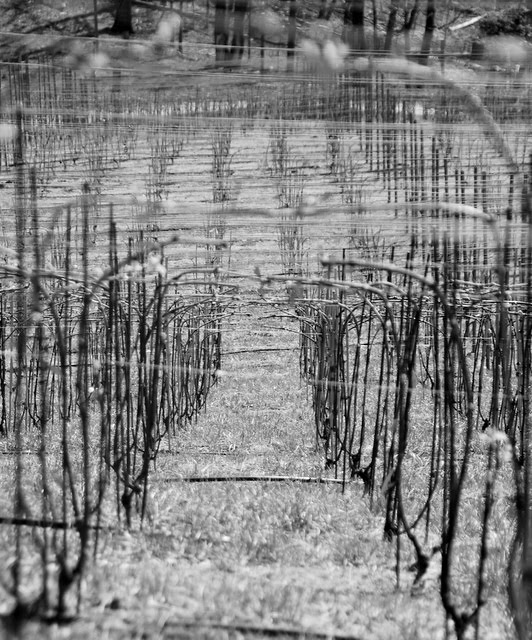
Pruning.. A New Winter Ritual During the months of winter, most of the time spent in the vineyard is pruning back the vines' previous year's growth, disciplining it into a new pattern of growth conducive to a manageable and fruitful vine. This is the first year we will be pruning primarily at the height of the fruiting wire, about 32 inches in our vineyard. Last year I took nearly all of the vines down to two buds at the base of the vine, just inches off the ground. I worked on my knees, bending down, bending over, sitting on a little rolling cart... you name it, I found that position, working essentially on the ground for nearly all of the 3500 vines. I look forward to seeing how many postures I can find myself working at this level, where I will again try to change positions often to alleviate repetitive motion issues.
Over the last couple of years, one of my goals has been to try to develop uniformity among the vines. So far, I have not come close. Maybe this will be the year!
Our vines' sizes vary from thin, spindly one-half inch diameter shoots no taller than two feet high to thick, sprawling canes with monstrous arms stretching eight feet along the top trellis wire. The reason for such discrepancies are many. First off; the size of the root systems of the plants varied immensely at planting. I remember trimming those roots before we planted them. Some vines' root structures were thick and almost hairy. Others had barely enough root to "take root". We expected it would take a couple of years for these slighted ones to catch up. Hopefully it will happen this year.
Another reason for the variation in size is the amount of water each plant was exposed to in the first couple of years. We had problems with the irrigation system during that crucial first year. The system couldn't reach all of the plants during a critical stretch of dry weather. Another issue particular to our vineyard is we have an underground spring that meanders down a swath of the vineyard. I have noticed that those plants over this area have grown much faster than those around them. The difficult issue with this is that the fruit from these particular vines might not develop the proper sugar concentration; in a sense they will have fruit with a higher percentage of water in them, thus a more diluted concentration of sugar and acid levels. This is something we will have to be measuring this year as they produce and ripen the fruit.
Our Vineyard Sleuth
We are thankful we have the opportunity to hire internationally recognized Lucie Morton as our consultant for this very important year. She brings with her a lifetime of work from around the world. She is a sleuth in the vineyard, discovering new diseases and seemingly always thinking ahead. She will be an invaluable asset for us. Our hope is she will find only healthy, happy vines, but ignorance is not bliss in a vineyard. Best to be on top of any little thing that pops up before it becomes a major issue. So we will stand strong and tall, and take any diagnosis she has to offer after she completes a thorough physical exam of our vineyard in early March. Stay tuned!
And Research Continues Remember our mystery product we field tested last summer for the Black Rot issue? A quick review... I found a patent for a product online, contacted the company. The product had not been used in vineyards but they sent it out anyway. I applied it to a test plot with repeated applications. Results were mixed for Black Rot, although it definitely reduced the number of leaf lesions. But I noticed a striking effect against Powdery Mildew. Because of this trial, we have the interest of a couple of universities who will be running field trials of their own this year. If their results duplicate mine, we might have generated an effective new weapon in the arsenals of environmentally sensitive vineyards in the East. I will keep you updated as the season progresses.
****************************
The Pleasures of Country Byways
Amidst the rural backdrop, my camera captures the unique beauty that exudes from every corner of this captivating countryside. Along the winding road through the woods runs the creek that I love, and from it I captured these frozen images of abstract beauty.
******************
And another type of ritual found in the deep hollows of the rural countryside.
With beautiful Mt. Pleasant in the background, our dear, loyal neighbors down in the "holler" use this area of their farm to "harvest" the hogs they raised the previous season. From these animals come a year's supply of fresh country sausage, pork ribs, bacon, ham, for family members (and a few lucky friends and neighbors). It is quite an experience to witness. It took me years of living here before I could actually set my eyes on the hogs that hang here... definitely not in a city girl's repertoire of familiar life events. Definitely not an image for our daughter, the vegetarian, who happened upon the sight last month while visiting! I still wrestle with the images, the death, the recycling of the hogs' lives. They live a good life here. Their demise is swift. There is no fear. Even after all that rationalization, I still find myself struggling a bit with it all. I never was a sausage eater. Until I tasted theirs. Oh, the sausage.... We thank you dear hogs. As the Native Americans did, we offer our gratitude and respect for the food these animals provide us.
***************************
In the midst of this Peaceable Kingdom below, notice the lone sheep, given to our neighbor as a gift for her months of tending to our flock in our absence. He has become a family pet and is happy, fat and finding companionship with the family of cows and horses who live together in this quiet, country place.

 Bella Learns About Lambs